
Request a Quote - New
"*" indicates required fields

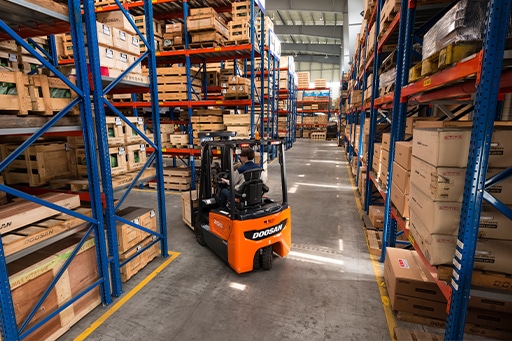
Imagine your warehouse as a bustling hub where every moment matters and precision is the key to success. In this dynamic setting, efficiency and productivity are not just nice-to-haves–they're the lifelines that keep your operations thriving. So, how can you unlock peak performance in your warehouse? It all boils down to two crucial factors: the quality of your material handling equipment and the intelligent strategies you implement.
Welcome to a journey that promises to transform your warehouse operations. In this comprehensive guide, we won't skim the surface–we'll dive deep into the heart of efficiency optimization. Together, we'll explore five essential tips for turbocharging your material handling equipment, ensuring your warehouse doesn't just run; it soars.
Selecting the right material handling equipment is the cornerstone of optimizing your warehouse operations and boosting efficiency. To make an informed choice, assess your warehouse's unique requirements thoroughly. Here's how to go about it:
First, pinpoint the specific material handling tasks that your warehouse routinely handles. These tasks encompass a wide range of activities, including:
Once you understand your material handling tasks, you can explore equipment options that align with your needs. When making your selection, be sure to consider factors such as space constraints, cost-effectiveness, safety compliance, and scalability.
It's often wise to seek input from supply chain management experts. Then, you can ensure that you choose equipment that maximizes efficiency and productivity in your warehouse.
Efficient warehouse layout and ergonomic design are critical in enhancing productivity and streamlining operations. Here's how you can achieve an optimized layout:
Begin by organizing your inventory based on demand and storage requirements. High-demand items should be easily accessible, while slower-moving or excess inventory can be stored in less accessible areas.
Ensure a logical material flow by reviewing production lines and the amount of inventory. Then, map pathways for items to move seamlessly from receiving to storage, order picking, and shipping areas. Minimize unnecessary handling and travel time to optimize efficiency.
Implement taller racks and shelving systems to maximize your vertical space. Investing in technologies like warehouse management systems (WMS) can provide real-time data and aid in long-term decision-making.
Remember to review and adjust your layout regularly to accommodate changing inventory needs and industry trends. Prioritize safety compliance to maintain a secure and efficient warehouse environment.
Your warehouse operators are the backbone of your operations. Well-trained operators are essential for smooth and efficient warehouse processes. On the other hand, inadequate training can lead to accidents, inefficiencies, and increased costs. Here's how to ensure your operators are well-prepared:
Provide comprehensive training programs to ensure your team understands equipment functions, safety protocols, and best practices. Regular refresher courses can help operators stay up-to-date with the latest technologies and techniques.
Modern telematics systems empower you to track your assets, boost efficiency, operate more safely, and avoid unexpected downtime. Here are some things to consider when it comes to telematics and fleet management:
What information do you want to get from your fleet daily? What do you want your team to have access to? Examples of telematics features that are proven to help any warehouse fleet are GPS location and geofencing, comprehensive reporting on fleet usage, on-screen OSHA checklists, impact reporting and collision lockout, battery monitoring for electric forklifts…plus many customizable maintenance features to help track periodic service and reduce downtime. These are just a few examples of how telematics can boost operational efficiency.
Regular communication and updates within your team are essential to ensure everyone understands their roles and responsibilities. Telematics contributes to a well-orchestrated warehouse operation.
Like commercial vehicles, your material handling equipment requires regular maintenance to operate optimally. Neglecting maintenance can result in breakdowns, downtime, and increased operational costs. Here's how to implement an effective maintenance program:
Regularly inspect your equipment to identify potential issues before they become significant problems.
Keep your equipment lubricated to reduce wear and tear and extend lifespan.
Replace worn-out or damaged components promptly to prevent equipment breakdowns.
These routine maintenance practices ensure that your equipment functions optimally and contributes to smooth warehouse operations.
If you need reliable material handling equipment, don't hesitate to contact ASCO Equipment. As your trusted partner for top-quality solutions in the field, we're here to assist you–whether you need to buy, rent, service, or purchase parts. With 27 convenient locations in Texas, Oklahoma, and New Mexico, we are ready to support your material handling needs.
Are you ready to explore a world of reliable Material Handling Equipment? Contact ASCO Equipment today to experience unparalleled customer service and top-tier equipment that drives your success.
We help you optimize your material handling equipment, boost warehouse productivity, and streamline operations. With the right equipment and strategies, you can unlock maximum efficiency and take your warehouse operations to new heights.

John Wright, Brax Wright’s son, joined ASCO in early 2013 as part of the third generation of family leadership. A proud member of the Fightin’ Texas Aggie Class of 2007, John earned a Bachelor of Science in Mechanical Engineering from Texas A&M University.
After graduation, John worked as a structural design engineer for L-3 Communications MID, specializing in C3ISR (Command, Control, Communications, Intelligence, Surveillance, and Reconnaissance) aircraft. In 2012, John completed a Master of Business Administration with a concentration in Strategy and Entrepreneurship from Southern Methodist University.
In January 2013, John joined the family business and played a key role on the Hi-Way acquisition team. He has since taken on a variety of responsibilities. He currently oversees the IT department.
In his spare time, John enjoys weightlifting, woodworking, cooking, and reading. He met his wife, Elizabeth Boothe, at Coronado High School while competing on the Math Team. Together, they have two beautiful daughters.

Courtney Vanderham, Steve Wright’s daughter, joined ASCO in 2010. She earned a Bachelor of Business Administration in Finance from Texas Tech University in 2005 and went on to complete her MBA at West Texas A&M University in 2007 while working at ASCO. Courtney later attended Tulane University, earning a Master of Finance (MFIN) with a specialization in Energy Derivatives and Risk Management.
Following her MFIN, Courtney worked as a sales and use tax consultant for Ryan Inc., North America’s largest tax consulting firm. She returned to ASCO in 2010, where she gained experience in the accounting department in Lubbock before transitioning to Amarillo. She currently serves in an Operations Manager role
Courtney is actively involved in her community as a member of the Junior League of Amarillo, Daughters of the Republic of Texas, and the Power of the Purse committee for the Laura Bush Women’s Health Science Institute.
Courtney is married to Zachary Vanderham of Visalia, California. Together, they have two children. The family share a love for sports, the outdoors, and spending time with friends.

Paula’s son, Chase Key, joined ASCO in 2009 and was the first of the third generation to return to the family business. He earned a Bachelor of Science in Industrial Engineering from the University of Oklahoma and later completed a Master’s degree in Management at Texas Tech University.
After graduating from the University of Oklahoma in 2006, Chase began his career with UPS as part of their engineering team. In 2009, he rejoined ASCO, gaining experience in various roles, including the service department, rental sales, and as branch manager for the Lubbock Case store. Today, Chase serves as South Area Sales Manager.
Chase is actively involved in his community as Vice Chairman of the Covenant Hospital Foundation Board and a member of the Lubbock Executive Association (LEA). An Eagle Scout, Chase fondly recalls completing a 50-mile trek in Canada, an experience that continues to inspire him. He enjoys outdoor activities such as hunting and golf.
Chase is married to Amy Collins of Stillwater, Oklahoma, and together they have three children.

Bill’s daughter, Paula Wright Key, and treasurer for ASCO, is also proud to be part of the family operation. She graduated from the University of Texas at Austin in 1979 with a Bachelor of Business Administration (BBA) in marketing. That same year, Paula married Charles Ellis Key and moved to Dallas, where Charles joined InterFirst Bank as a Vice President.
In 1988, Paula and Charles returned to Lubbock, and Paula began her career at ASCO, working in the accounting department, working with payroll and accounts receivable.
Paula has been deeply involved in her community, serving on various boards, including the Texas Tech Foundation Board, Hospice of Lubbock Board, the Laura W. Bush Institute for Women’s Health, and the Board of Trustees for All Saints Episcopal School.
Paula and Charles have two children, Charles Ellis Key Jr. (Chase) and Carolyn, as well as four grandchildren.

Steve Wright graduated from Texas Tech University in 1974 with a degree in Business Management. Shortly after, he joined his father and brother at ASCO, where he gained experience in nearly every role within the company.
In 1982, Steve and his family moved to Casper, Wyoming, where he managed ASCO Equipment-Wyoming, a Clark-Michigan distributorship serving the state. In 1984, he returned to Amarillo and now serves as President of ASCO.
Steve and his wife, Lea, are deeply involved in local, state, and national politics. Steve has also contributed to his community by serving on several boards, including Senate District 31, the Amarillo Executive Club, the Texas Tech Red Raider Club Board of Directors, and the Advisory Board for Wells Fargo Bank, among others.
An avid outdoorsman, Steve enjoys hunting and fishing. Steve and Lea have three children: Robyn, Courtney, and Brandon.

Brax graduated from the University of Texas in 1971 with a Bachelor of Science in Mechanical Engineering. After graduation, he began his career as an Offshore District Project Engineer for Exxon. He also served in the United States Army Reserve for six years, achieving the rank of sergeant in a heavy construction battalion.
Brax has held nearly every position at ASCO, gaining invaluable experience across the company before becoming Chief Executive Officer in 1997. Over the years, he has also served on numerous manufacturer advisory boards as well as other bank and company boards, contributing his expertise to guide key decisions.
Outside of work, Brax teaches the Adult Seekers Sunday School class at First Christian Church, where he serves as an elder. In his spare time, he enjoys golfing, camping, fly-fishing, reading, and writing. Brax is married to Beth, and together they have two children, John and Jill, and five grandchildren.